
The scoping process starts the chain of events of BLM looking for public input about the upcoming roundup in Spring Creek Basin. We also understand that it is a time when public comments advise BLM of “alternatives” the public would like to see – these then come out in the EA, which provides another opportunity to comment.
A roundup and removal of some horses needs to happen, and it needs to happen while the horses are in good condition – not when they’re in poor condition. An annual PZP darting program is necessary and appropriate to integrate into the management plan of Spring Creek Basin Herd Management Area.

When you make your comments in support of annual PZP darting by trained volunteer darters in Spring Creek Basin (and please do support us in exactly this, not more use of PZP-22), focus on these areas:
* Cost – This is perhaps the biggest in getting BLM’s attention. A complete dose of PZP (PZP + adjuvant + dart) costs less than $30 per mare. That’s no typo, and I’m not missing a zero. PZP-22 is about $200, and it currently requires the additional expense of a roundup to capture the mares and deliver. Native PZP does not require a roundup, does not require handling the mare in any way, so it’s also less stressful to the horses. And with fewer foals born, less potential for those grown-up horses to end up in holding, which is another massive expense for the Wild Horse & Burro Program. Labor provided by the Science and Conservation Center-certified volunteer darter(s) who knows and has complete documentation of the horses – FREE. Paperwork/record-keeping done by volunteer darter(s) – FREE. Cost to BLM to implement the annual PZP darting program – FREE. The Colorado chapter of the National Mustang Association has offered to pay for the first period (to be laid out in the EA as a five-year period, we hope) of PZP. This will be in our formal comments; we made the oral offer to BLM at our recent Disappointment Wild Bunch Partners meeting.
* Genetics – Roundups and removals completely remove genetics of horses that have never contributed – the youngsters. Reducing the frequency of roundups by use of PZP will allow more horses to contribute their genetics over a longer period of time – even though fewer horses are reproducing at any given time. Because of the small size of the Spring Creek Basin herd (AML = 35-65 adult horses), we foresee that periodic introductions of mustangs from similar herds will continue to be necessary.
* Social – PZP is far less disruptive to the horses than roundups and subsequent removals. PZP does not inhibit a mare’s cycles at all, so yes, she will continue to come into heat. The “disruption” of bands in the Spring Creek Basin herd has been minimal and, as far as I can tell, not related to the PZP-22 several of the mares have received. It worked on Alpha – she has been with the same band/stallion since she was released after the 2007 roundup. It worked on Mona – she was with the same stallion until she foaled in 2010; when she went off alone to have her foal, she was picked up by a different stallion. It worked on Raven – she came to us pregnant, and when she went off to have Corona, she ended up with a different stallion; after about six months, she ended up back with the original stallion; she did not foal last year; she looks on track for a spring foal. It worked on Kootenai – she has been with the same stallion with one brief exception (which seemed to be to go get Raven) since her arrival. She ought to have a foal this year, but so far, she does not look pregnant. The other surviving SCB mares have been with the same band since their release – with the exchange of a single band stallion for a dominant band stallion and three bachelors, one of which may be the mature son of one of the mares.
* Safe for the mares – PZP does not harm either the mare or the fetus she may be carrying at the time of application (of either primer or booster). PZP is a protein derived from pig eggs. It simply blocks fertilization of the mare’s egg by the stallion’s sperm. It does not cause a mare to develop masculine features – it is a protein. Mares in herds where PZP has been in long use (example: Assateague Island) are living longer, healthier lives – the result of not having babies year after year after year.
* Low stress/no handling – PZP is administered by remote dart when biologically appropriate. The mares aren’t rounded up, they aren’t tranquilized, they aren’t touched except by the dart. I won’t say there’s no stress to being darted, but compared with a roundup and separated from family members?? No comparison. Very low.
*Effective/successful at preventing pregnancy – PZP has at least a 90 percent efficacy (success) rate. On Assateague Island, as of last year, it’s 95 percent successful. We don’t want to stop reproduction; we want to slow it. No adult horses died last year, which means it’s not very realistic to think that we’ll equal birth and death rates.
* Branding of treated mares – Unnecessary because of extensive documentation of 100 percent of horses in the Spring Creek Basin herd.
*Excessive gender skewing – Unnecessary because of documented efficacy of native PZP.
* Removing horses to the low end of the AML – Unnecessary because of the documented efficacy of native PZP and potential slowed growth of the Spring Creek Basin herd.
* Ask also that bait trapping be used as a more humane alternative to driving horses with a helicopter. This requires more time and patience (when is that ever a bad thing with horses and/or wild animals?) and a temporary holding facility onsite or very near – which I have a lead on. We have pushed for this since 2007 … keep it on BLM’s radar! Dan Elkins, who does bait trapping, is just south of us in New Mexico, and he uses bait trapping very effectively on the Carson National Forest and Jicarilla Wild Horse Territory – also the first Forest Service-managed herd to use PZP.
Other comments to make about the roundup itself:
* During the heliocopter gather, bring the horses in band by band and corral them that way to avoid the injuries suffered by forcing unfamiliar horses together.
* Instruct the contractors and other handlers to be careful NOT TO OVERSTIMULATE the horses with their flagging, which often causes the horses to become very frightened, unduly stressed and often injured by jumping into panels. This is not contemporary or humane handling.
* Be certain to use grass hay – not alfalfa.
* Provide water and salt immediately as many of the horses have been driven from the southern end of the herd management area. (The trapsite is at the upper western edge of the basin.)
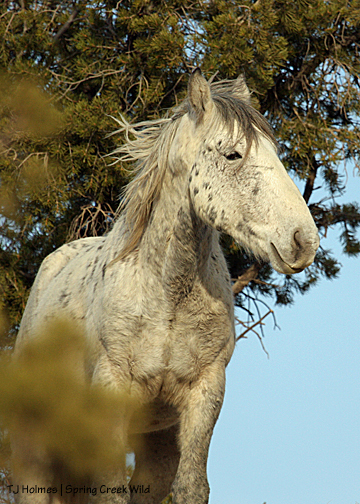
Spring Creek Basin and its mustangs meet all the criteria: Check out again this FAQ card I created.
Talk about the horses. Call them “wild horses” or “mustangs” – beings that have touched your heart, that you admire, that you love. Make frequent use of their homeland’s name: “Spring Creek Basin.” This is not a random herd. This is not an unknown place. Yes, it’s remote. Yes, it’s small and out of the way. The horses are no less beloved for those facts. In fact, they ARE beloved – the “stats” on this blog tell me that – almost 70,000 hits in three years. YOU love these horses. Tell BLM – and back it up with these facts about why it should implement an annual PZP darting program in Spring Creek Basin using trained volunteer darters.

Do use these facts to make your case in your comments for the use of an annual PZP darting program here with trained volunteers. The way this works is that BLM needs you, the public, to make this information known – for this herd – ahead of this roundup. What can you do for our mustangs? … I hope I’ve just given you a way. On behalf of the mustangs of Spring Creek Basin – for their well-being and healthy future, I THANK YOU for helping us help them!


Thanks, TJ. This is exactly what I needed for reference. Do you think we should say anything about bait-trapping at this time, or just concentrate on PZP and hope it will slow reproduction to a point where a helicopter roundup would be a rediculous expense?
Since use of the same system has proven successful at Little Book Cliffs (and where else?), I think they should split the difference in the AML and leave at least 50, including some of the younger mares for genetic diversity. This would also provide additional protection from catastrophic loss (mentioned in the BLM’s 2007 Gather Plan).
As I remember, the fear of loss was their primary argument against using PZP (PZP-22?) in 2007, but I may be wrong.
Yes, by all means mention bait trapping! I thought I said something somewhere about PZP + bait trapping … but I’m trying to talk to lots of people and get info out here and trying to use “social media” – aka Facebook – and I lose track of where I say what. But yes, in a nutshell, what I’d like to see here is a sustainable fertility control program – darting annually with PZP – to reduce our “gathers” to once per decade. Then, when necessary, I’d like to see bait trapping replace helicopter-driven roundups. You can say what you like in your comments, of course, but keep in mind that BLM considers helicopter roundups humane. It doesn’t help the cause at all to call them inhumane (no matter what you actually think of them); the best approach is to call bait trapping “more humane” – because that’s what BLM itself touts – looking for best science and the most humane approach. The helicopter contractor roundups are very expensive – even though the “per head” cost seems relatively low. Dan Elkins’ “per head” cost is higher – but it’s inclusive. If it takes us a decade to get a little over AML and we can remove just 15-20 horses at a time – to get back within AML but not to the low end – that’s just $15,000 to $20,000 – once a decade! As opposed to ~$75,000 (approximate cost of 2007 helicopter roundup in SCB – and we also had roundups in 2000 and 2005). Where to keep the horses while Dan’s collecting them? I have a lead on that. 🙂 And volunteers to feed/hay/care for the horses while he collects them before an adoption? That’s where NMA/CO and the Disappointment Wild Bunch Partners – and all our groups – come in. A chance to adopt a Spring Creek Basin mustang just once a decade? Can we drum up demand for a “rare” “commodity”? Like I said – that’s the goal(s) in a nutshell.
And yes, I keep hearing “what if there’s some catastrophe?” The biggest catastrophe I’ve heard about in the basin was in the early 1990s, when the herd population got up to about 130 horses and there was such trauma and stress from lack of forage (and water, I assume) and the roundup that many died. That’s a human-caused catastrophe. On Pryor Mountain one year, all but one foal died – remember that? And yet look at the herd today. Result? It’s a legitimate concern … but it doesn’t outweigh the immense benefits of PZP. I’m not sure what the argument was against PZP-22 in 2007 (native PZP has never been used here). As I recall, its use was in doubt until nearly the last minute. NMA/CO paid for it … but there was some trouble there getting reimbursed by BLM for the amount not used. We didn’t get Little Book Cliffs mares – their roundup was less than a month after ours – for the stated reason that they were getting “just” the one-year PZP. Oh, if only we’d known then what we know now … 🙂 But it turned out fine. I love our Sand Wash Basin girls as if they’d been born here.
Just what we needed! We’ll get something together right away! Thanks, as always!!